20 December, 2009

'Lord of the Flies' with Middle East in mind

For some, the book was and is considered: profane, cruel, 'not representing' normal values and dangerous. Many have hated its brutal tone. Many say it is atheistic. For others, William Golding's first novel: Lord of the Flies, is one of the most creative and greatest novels of all time.

First published in 1954, fiction, provocative, intense and very absorbing - no doubt, the book is. But, whoever likes reading books that makes one intensely think, ponder and wonder, then Golding's masterpiece is a must read. Not because it was the main reason for the writer being awarded the Nobel Price for Literature in 1983; Lord of the Flies is beautifully written and is as relevant today as it was, then, just after World War II and during the Cold War. Just as it will always be reflective of human nature as long as we humans exist.

19 December, 2009

Google for Humanity

With the fiasco at Copenhagen, we now know that world leaders can not do much when it comes to Climate Change and other like problems that humanity face. Most world leaders are politicians who are more swayed by votes and economics than by doing what is right for humanity. But independent organizations and other world bodies can do much to change the World for the better. And that is what Google is doing.

17 December, 2009

An Evening with Camels in Mukalla

Camels. In Australia they are brutally butchered; not for their meat; not for their skins; but simply because they are considered 'feral', 'pests' and a 'problem'. The recent 'culling' of camels in Australia's Northern Territory cost its government about 50,000$; enough money to have dug boreholes for the camels which roam from place to place in search of water. The one humped, Arabian Camels were introduced to the mainly arid Australia, for transport, in the mid 18th Century; but since then, they have rapidly been increasing in numbers. As Australians have no other use for them, they have repeatedly reduced the population of camels, by cruelly shooting them either form planes in the air, or by chasing them on moving vehicles. How barbaric. Had some poor, developing country been doing that to marauding lions or elephants - how would Australians have felt?

Camels should never have been taken to Australia; as people there have no liking for or understanding of the amazing animals. Had Australians understood this wonderful creature, they would have known how to benefit from it; they would have known how to use it; and they would have known how to respect it. Benefit from it; use it; and respect and value it as we do here in Hadhramout

African elephants, which I have many times seen at very close range - have always greatly awed and amazed me; and so have camels. A few days ago, I spent an evening with these extraordinary animals. Just a few meters from the center of Al Mukalla, is  a market for camels:

11 December, 2009

Google vs Bing

Both Google and Bing are changing fast. very creative. And upping the bar. Good for us surfers.

07 December, 2009

Books on Soqotra

When, almost three years ago, I first wrote on Soqotra on this site - I did so very hesitantly. I very much wanted to write about this unique, fascinating island and to let people know about it; but, at the same time, I kept thinking that - the more people know about Soqotra, the more it might get attention and visitors. Visitors: ......tourists and businessmen. Tourists: to feast on the wonders of Socotra; businessmen: to make money from those wonders. Yet: both are good for the Island but at the same time - they can be destructive.

I finally decided to write that article; I felt that, at the same time - the more attention is brought on the Island, the more people might be concerned about it. What very much surprised me then, three years ago when I did an extensive search on 'Soqotra' or 'Socotra' on the Internet, was that - the Island had very little written about it in English. Very thankfully, last year - UNESCO recognized the island as a world natural heritage site and it now has world attention.

Ibn Battuta, the great Moroccan traveler, explorer and writer - never visited Soqotra. He should have. I would have very much loved to read what he would have said about the stunning Island. But another great traveler, explorer, adventurer and writer, did visit Soqotra: Marco Polo. He mentions the Island in his book: The Travels of Marco Polo.

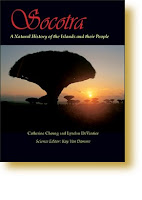
There are a number of good books on Soqotra. Socotra: A Natural History of the Islands and Their People is most probably the best to read. It covers in much detail the full history of the fauna, flora and people of the Island. Richly illustrated, it's a very well, scholarly and comprehensively written book.

06 December, 2009

Be the Change!

In the next few days, World leaders will decide on how to control the effects of Climate Change. Many countries will be at Copenhagen for the conference, but only a handful of rich, powerful countries' decision will matter. For the poor, developing nations, like Yemen - although they have the least adverse effect on climate and are the most affected by Climate Change, they will have the least say at the conference.

Developing countries account for very little of the global greenhouse emissions, and yet poor nations will suffer the most as climate continues to change. Being one of the most water scarce regions, the Middle East is particularly vulnerable to Climate Change. Heavy rains and floods, as happened in Hadhramout in late 2008; and recently in Saudi Arabia - can be very devastating. The adverse effects of last years rains here, and the flooding that followed - are still being felt today.

If global warming continues and temperature rises by just 1.5º Celcius - the cost to Middle East countries, will be even more. Whichever way climate change affects the Middle East - causing drought or more heavy rains and flooding - it will be a cause of much suffering and hardship to many. Drought and lack of rain, can be as devastating as having heavy rains. Many parts of Yemen, this year, are dry; less food has been harvested. Meaning more hunger. Already, there is much less water now in Syria and Jordan than there was a few years ago; rivers are drying up. It's reported that even the mighty Nile, has less water now. And so are the Euphrates and the Tigris.

Climate Change has a ripple, domino effect. By causing less rain or heavier rain, crops will either not grow or will be destroyed by flooding. Meaning less food will be produced; meaning the prices of  food going up. Flooding too, leads to diseases - like: malaria and diarrhea, two of the deadliest. And if it rains less, it leads to drought and drying rivers; which in turn leads to multitudes abandoning farming and moving to urban centers, as is happening in Syria and in many other Arab countries. As more people move away from farming, less food is produced forcing the importing of more food; importing more food - food which is already expensive - diverts financial resources that could be used in providing for other necessities for a country. All these, in turn lead to more malnourished children, more hunger, more misery and more people dying. Hunger and the shortage of food, causes civil strife and disturbances. Leading to countries being destabilized. And more crime.

05 December, 2009

Dar Al Hajar: the Inside

Dar Al Hajar from the outside, is awesome and imposing; and so is the inside. The ingenuity of Yemeni architecture is as evident inside as it is outside. One is astonished with what one sees outside this unique building; inside, for a building that was built at the beginning of the last century, one is even more amazed at the care and ornateness that is there. It was built and decorated by master craftsmen. Here are some photos of inside the Rock House:

04 December, 2009

Dubai still has the Ball

Dubai. It has the tallest building in the world. It has one of the largest and busiest airports in the world. It has the largest man made harbor in the world. It has one of the largest man made ski resorts in the world. It has the first underwater luxury resort in the world. It has the first urban train network in the region, and when completed, it will be the longest automated metro network in the world. It is a city of record breakers and impressive firsts; and festivals and partying. A city of theme parks, of mega shopping malls, of horse-racing courses, golf courses and yachts. It is the most important sea port and the main trading/financial center between London and Hong Kong. It has and is building some of the most stunning, amazing structures on Earth. And it is home to some of the wealthiest people on Earth.

03 December, 2009

Dar Al Hajar: the Outside

Dar Al Hajar - the Rock House, in Wady Hajar, a few kilometers from Sana'a - is a must place to see, for any visitor to Sana'a. Not to see the Rock House, is not to see Sana'a. Most people who go to Sana'a, miss visiting this glorious work of art.  Here are some photos of the Dar that I took recently:
The Web Search Out Of Hadhramout

Blogger Template by: Ourblogtemplates.com 2008 | RSS S Feed | Copyright © Out Of Hadhramout | 2006-2011